01 / Overview and method
Different bodies
A shared language of motion
EgoLAP learns from egocentric human and robot trajectories by expressing motion intent in language. Structured language actions describe what to do; motion-level reasoning explains why the motion fits the scene.
Share of each training batch
EgoVerse
25% MECKA 20%
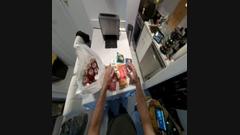 Scale 4.15%
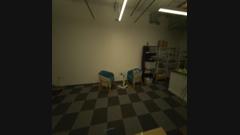 Aria 0.85%
ABC YAM
30%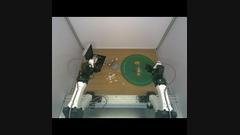 ABC YAM 30%
Other bimanual
25% AgiBot 15%
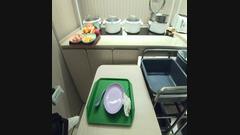 Galaxea 5%
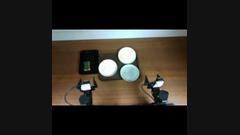 MolmoAct2 5%
OXE
20% DROID 12%
 Fractal 5%
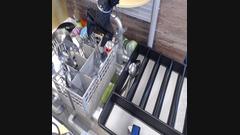 Bridge 2%
Other OXE datasets: 1%
Different motions can serve the same intent
Humans and robots can use different motions to achieve the same physical effect. The underlying intent is what generalizes. To generalize across embodiments, models need to understand why a motion works. Direct behavior cloning can leave this signal too implicit for the model to extract. Motion-level reasoning makes it explicit by connecting contact, geometry and object affordances to the intended effect.
Model Architecture
Motion-level reasoning
“Maintain the grip to carry one side over the other.”
Language actions
“Move forward 4 cm, move down 1 cm…”
Continuous actions
End-effector poses + gripper commands

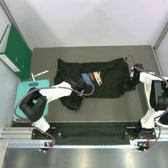
Example input from either embodiment
Fold the cloth into a square
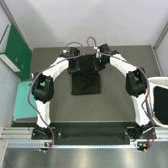
Different trajectories; shared intent: secure the cloth and bring one half over the other.
 AlignLift
 Fold
Fold Press
PressThe left hand maintains its grip and shifts rightward, bringing the left side over while the right hand anchors the opposite fold.
L: move forward 4 cm, move down 1 cm…
R: move back 5 cm, move down 4 cm…
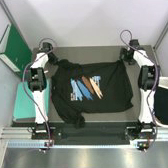 AlignLift
 Fold
Fold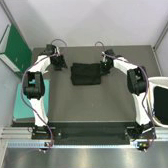 Press
PressWith both corners firmly grasped, the arms lift upward and advance to fold the lower half over the upper half.
L: close gripper, move forward 7 cm…
R: move forward 7 cm, move up 4 cm, keep gripper closed…
02 / Evaluation
Zero-shot performance on
unseen robot configurations
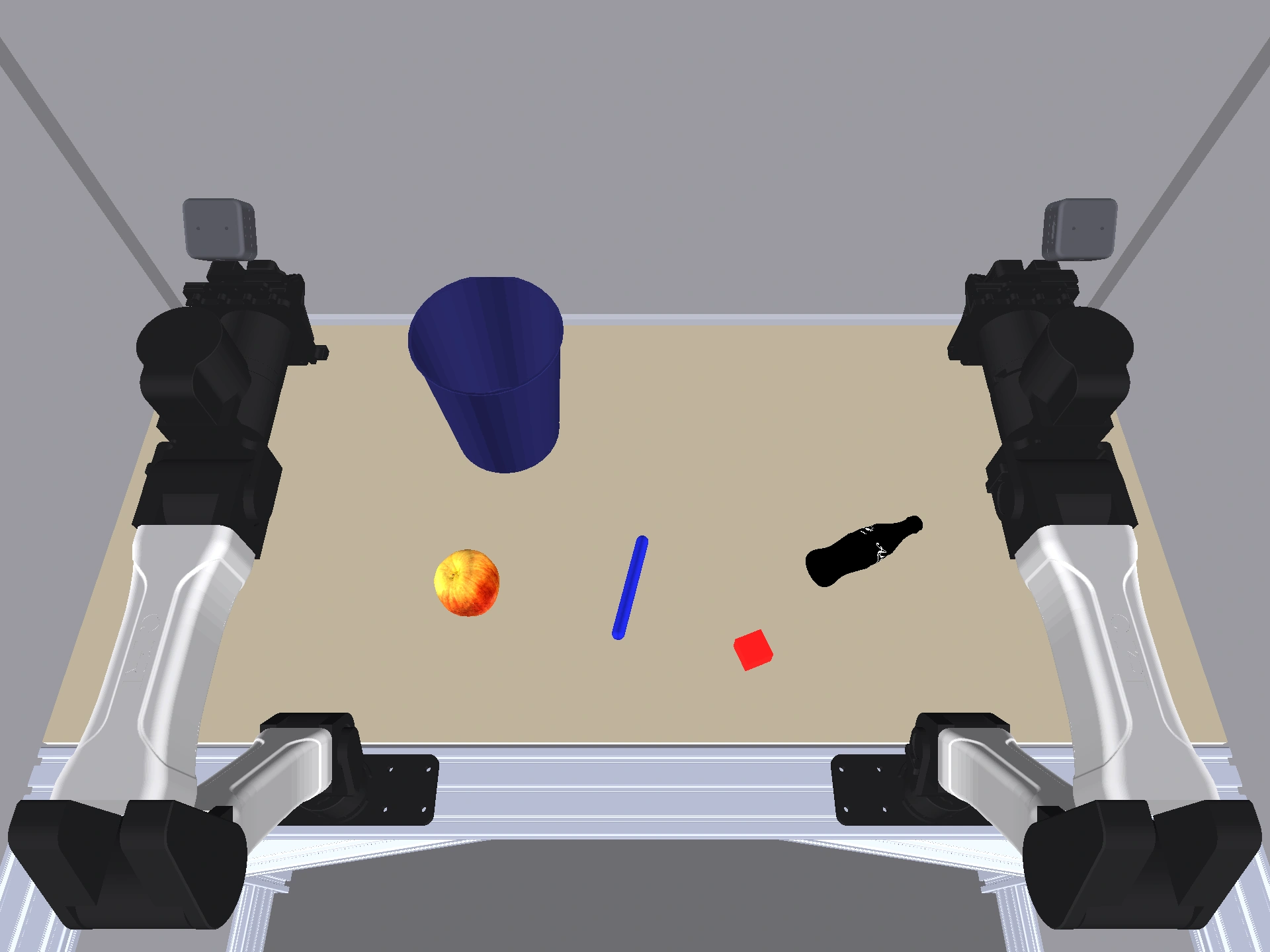
We evaluate on a customized bimanual YAM robot with unseen arm placement and camera configuration, and on 14 simulated tasks. No model is trained on simulation data. EgoLAP reaches 80.1% mean task progress in the real world and 38.3% success in simulation.
Mean real-world task progress
Gain over alternative action representations
Zero-shot simulation success
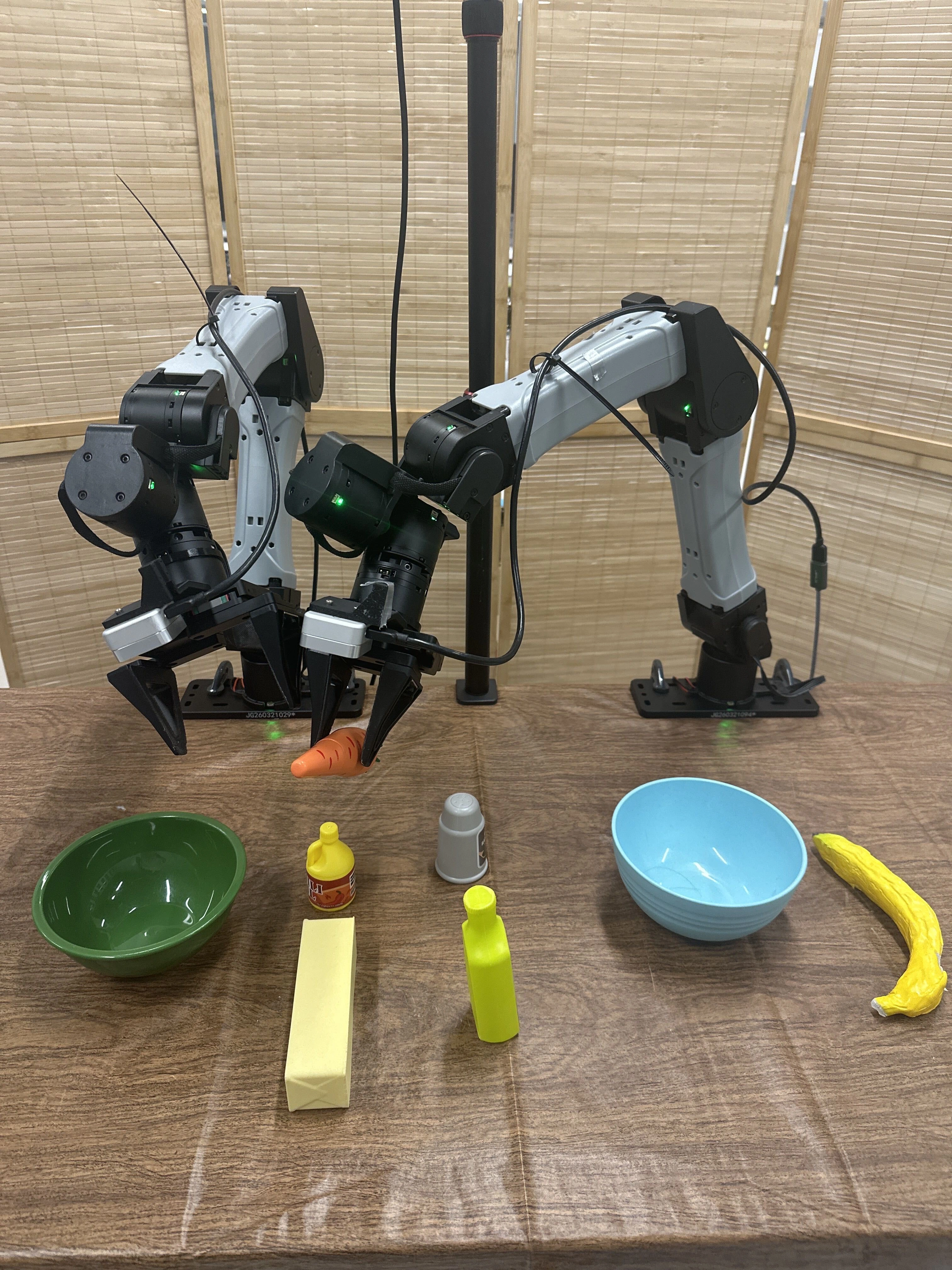
Real-world task progress
Open original ↗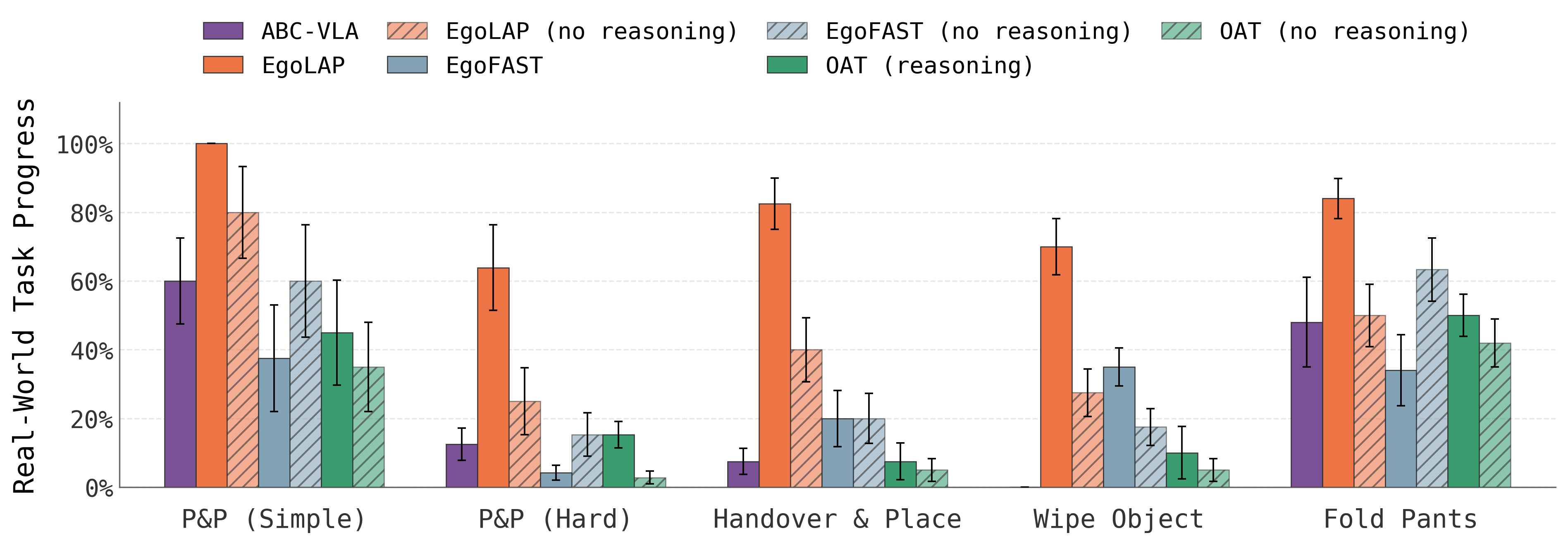
Zero-shot simulation success
Open original ↗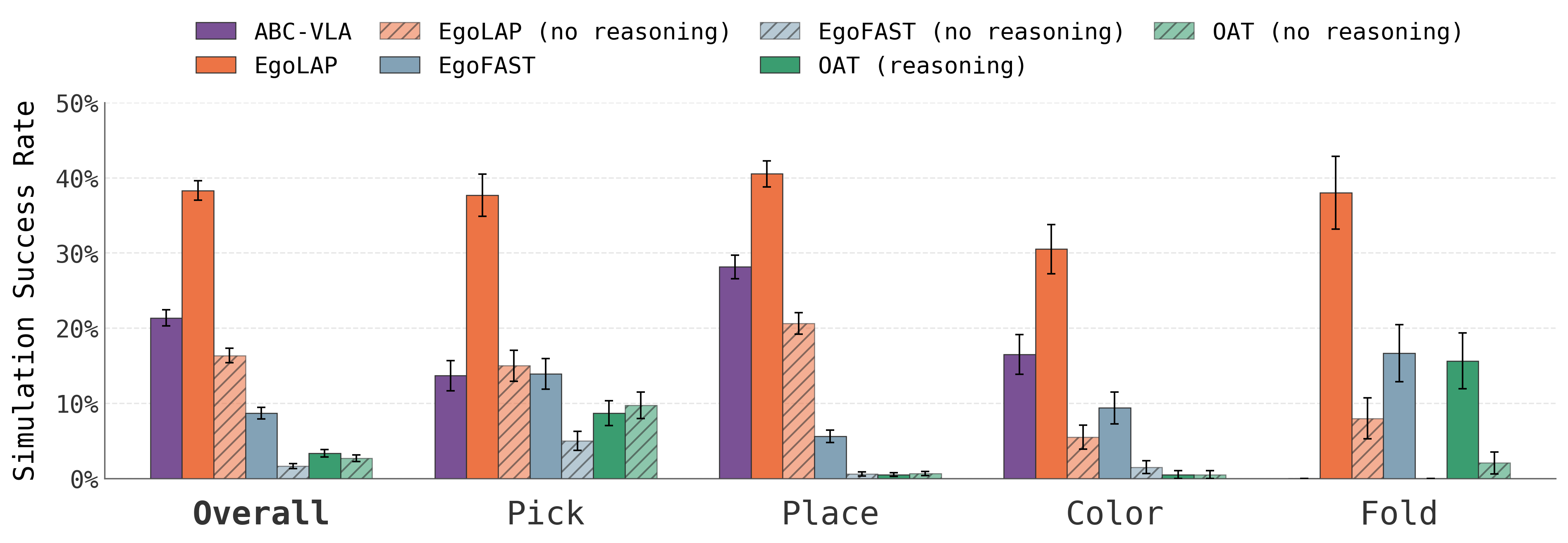
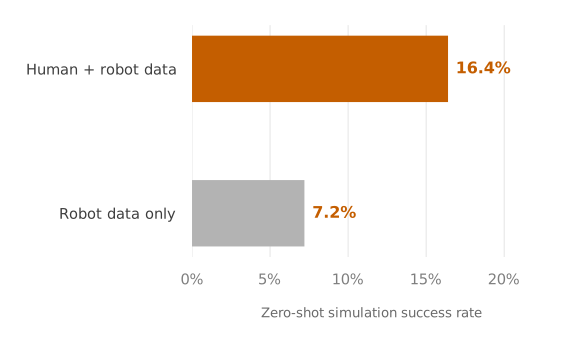
Human data makes a difference
With the language-action representation held fixed and no reasoning supervision, adding egocentric human data raises simulation success from 7.2% to 16.4%—a 2.3× gain.
The simulator is unseen during training, making this a direct test of transfer across both embodiment and visual domain.
03 / Real-world rollouts
Zero-shot evaluation videos
Zero-shot on an unseen YAM configuration, with no fine-tuning on the evaluation setup. Select a task to explore the rollouts.
04 / Beyond pre-training
Effective Post-training
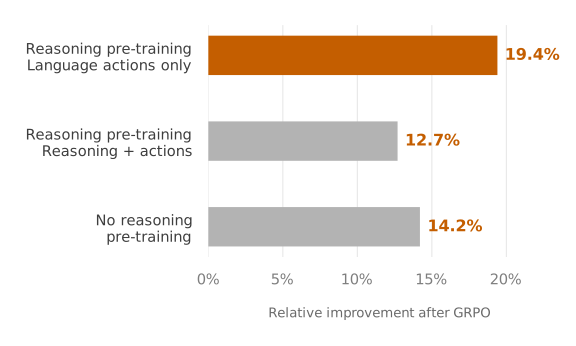
Reinforcement learning on language actions
Structured language actions are machine-parseable and can be scored against demonstrated motion. GRPO post-training improves simulation performance while keeping the vision encoder and continuous action expert frozen.
Sampling language actions without generating reasoning gives the stronger improvement in this experiment. Deployment continues to use continuous actions without decoding text.
Citation
@misc{zha2026egolaplearningegocentrichuman,
  title={EgoLAP: Learning from Egocentric Human Data through Language-Action Reasoning},
  author={Lihan Zha and Shresth Grover and Tenny Yin and Samuel M. Bateman and Hengkai Pan and Mengchao Zhang and Aykut Onol and Allen Z. Ren and Dhruv Shah and Anirudha Majumdar},
  year={2026},
  eprint={2610.08726},
  archivePrefix={arXiv},
  primaryClass={cs.RO},
  url={https://arxiv.org/abs/2610.08726},
}